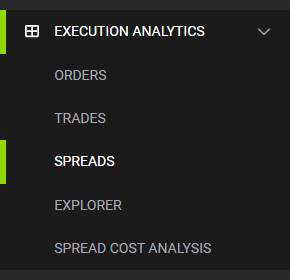
Spreads are measures of market liquidity and implicit trading cost and come in several different flavours. Spread analytics can be found in this menu.
While generic spreads relating to any given market or instruments are easily found in public data, it is more difficult to obtain measures of the actual spreads experienced by trading firms without significant work to capture the data and analyse the results. JSE Trade Explorer provides this capability together with comparisons between your data and the market average.
Quoted Spreads
Quoted Spreads are the simplest form of spread metric, giving an indication of the expected overall cost of trading. In JSE Trade Explorer, they are calculated as (OFFER PRICE – BID PRICE) / MID PRICE and weighted according to the value of your fills. This means that the Quoted Spread that you see in JSE Trade Explorer is what your orders have actually experienced at the time of the trade rather than a generic unweighted spread over the day. The spread calculation is therefore “personalised” to your order flow and can be compared to the market average. An example of how the data can be interpreted is that if your measure value is less than the market average, this could indicate that in general you are trading at more liquid times of the day.
Effective Spreads
Effective Spreads represent the spread at the exact moment of a trade, calculated as (TRADE PRICE – MID) / MID. Note that this calculation gives a measure which is approximately half of the Quoted Spread. The Effective Spread can be seen as the immediate premium paid for taking liquidity (aggressive trading) or saved when providing liquidity (passive trading) using the MID as the reference price for fair value.
Realised Spreads
Realised Spreads can be thought of in the same way as Effective Spreads, and are calculated the same way, but with a time offset to capture further changes in the order book state shortly after your trade. Prices change in response to trades and therefore other subsequent price movements may be considered as part of the impact (and therefore cost) of your trade.
For example, when several trades take place sequentially at the bid price, the presence of one or more sellers may be assumed and if the quantity at best BID is exhausted other buyers may set their quotes lower. The Realised Spread measure therefore takes these broader effects into account by introducing the time window. Realised Spreads in general are larger over time, especially during periods of volatility.
How To Access the Service
If you are an existing user of the JSE Trade Explorer, please follow this link and login using your existing credentials: https://jse.big-xyt.com/login
If you are a new user, please register for the service by following this link https://jse.big-xyt.com/signup and follow the instructions.
Feedback, Suggestions and Support
Please send feedback, questions or issues to [email protected] or use the form on the “Contact Us” link in the footer of all user views. We would appreciate as much information as possible such as:
- name of the window,
- any non-default filter settings,
- date range,
- symbol or stock selected.